
7 Feet Tall in His Own Mind: The Antonio Pemberton Story
Some players need the game to tell them they’re special. Others step on the floor already believing it. Antonio Pemberton belongs to the second group. @prospectu_gee

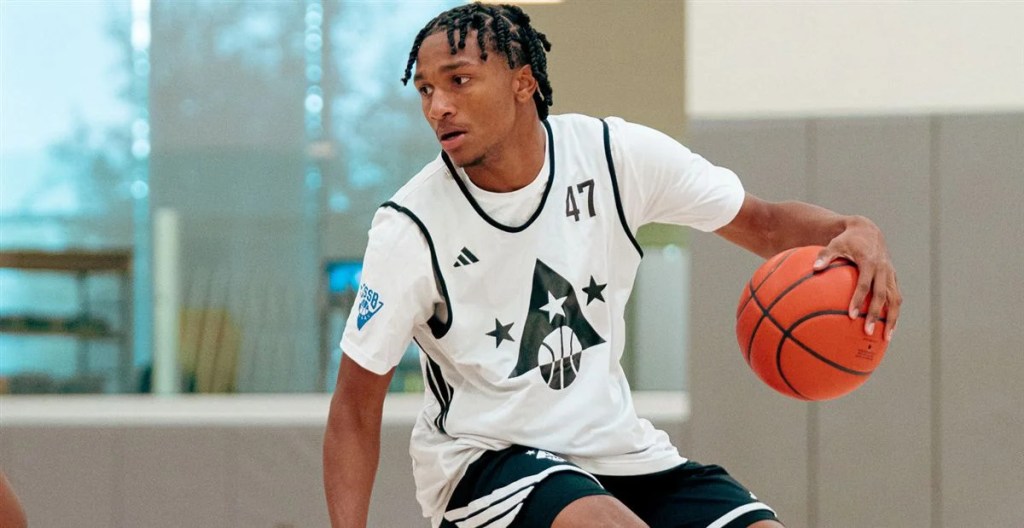


There are two versions of Antonio Pemberton. At least that’s how his AAU coach describes him. And after watching the Mass Rivals guard compete, I understood exactly what he meant. Because somewhere between the moment Pemberton walks onto a basketball court and the moment the ball gets tipped, something changes. The personality shifts. The competitive switch flips. And suddenly, this 6-foot-1 guard is moving around the floor like somebody forgot to tell him he’s not seven feet tall. Or that there’s supposed to be somebody better than him out there.
That’s the thing about confidence. Real confidence. It doesn’t ask for permission. And Pemberton doesn’t appear to be asking anybody for anything. Not respect. Not recognition. Not a seat at the table. He’s coming to take his.
You Can’t Measure What’s Inside Somebody
Basketball has become obsessed with measurements. Height. Wingspan. Vertical leap. Rankings. Stars. Offers. We measure everything. Except sometimes the very thing that separates the good ones from the ones who actually change games.
That competitive spirit. That internal belief that no matter who’s standing across from you, you’re not backing down. It’s the reason I kept finding myself drawn to Pemberton while watching Mass Rivals. Not necessarily because of a highlight, or because of a ridiculous scoring explosion. But because of the way he approached the game.
There was something about his competitive energy that demanded attention. Something about the way he carried himself that made you watch a little longer. In a basketball culture where individual exposure can sometimes overshadow winning, Pemberton competed like the final score still meant more than the individual spotlight. And that’s different. Because there are players who want to look like the best player on the court. Then there are players who genuinely believe they are. Pemberton plays like the latter.
Everybody Wants Buckets. Not Everybody Wants the Fight.
Don’t get it twisted. Pemberton can score.
The Michigan State commit spent the summer establishing himself as one of the country’s most dangerous offensive guards. He helped lead Mass Rivals to the adidas 3SSB 17U championship game, averaging 26.2 points per game during the championship tournament.
The scoring is documented. The shotmaking is real. But what interested me most wasn’t how many points he could put on the board. It was how much of himself he was willing to put into the game. Because the game doesn’t always need another bucket. Sometimes it needs somebody to compete harder. Somebody who understands the emotional temperature of a possession. Somebody willing to make an impact that doesn’t necessarily get clipped, reposted or celebrated.
His value wasn’t limited to whether the ball went through the net. His competitiveness was part of his production. The mentality mattered just as much as the skill. And that’s a distinction we don’t talk about enough when evaluating young players.
You can teach somebody how to get to a spot. You can develop a jumper. You can improve a handle. But teaching a player to genuinely love the fight? That’s a different conversation.
The Other Side of the Jersey
When I spoke with his AAU coach, the description of Pemberton being two different people stayed with me. Because I think that’s what makes this story bigger than basketball. We sometimes confuse the loudest personality with the strongest competitor. But those two things aren’t always connected. A player doesn’t have to walk around telling the world how good he is. Sometimes the confidence lives somewhere deeper, and when the lights come on, it reveals itself.
His coach described a player who steps between those lines believing he’s seven feet tall and the best player on the floor. Think about that. Not hoping he belongs. Not wondering whether he can compete.
Believing.
There’s a freedom that comes with that mentality. You stop playing to protect your reputation and start playing to impose your will. You stop worrying about who’s ranked ahead of you, who’s watching from the baseline or whose name carries more weight.
You play basketball.
To win.
And maybe that’s the part of Pemberton’s makeup that resonated with me the most. The game still means something personal to him.
The Game Recognizes Its Own
There was a moment this summer that seemed to capture the mentality perfectly.
Mass Rivals was facing Compton Magic in the adidas 3SSB championships. The game was hanging in the balance, and with Mass Rivals trailing by one and the game hanging in the balance, Pemberton buried a fading jumper from the left corner over 6-foot-10 Darius Wabbington, sending Compton Magic home and Mass Rivals into the quarterfinals.
The kind of shot that requires skill, yes. But also the kind of belief that doesn’t recognize the size of the moment as a reason to hesitate. That’s what separates confidence from performance. Some players are confident when everything is going right. Others remain confident when everything is on the line.
Pemberton has shown he can embrace the latter. And maybe it makes perfect sense that he’ll be playing for Tom Izzo at Michigan State.
Because underneath all the shotmaking, creativity and offensive skill is a competitive identity that feels built for a program where toughness and winning have always meant something. The destination isn’t what makes this story interesting. It’s the mentality that helped get him there.
When I think about Antonio Pemberton, I don’t think about the rankings, the offers or even the Michigan State commitment.
I think about what his coach told me.
Two different people.
One away from the court, and another who steps onto it believing he’s seven feet tall.
Funny thing about basketball. Sometimes the biggest player on the floor isn’t the tallest one. And sometimes the most important things a player brings to the game are the things you can’t measure.
KNOWN UNKNOWN
For the ones they overlooked. And the ones whose stories deserve to be told beyond the rankings.